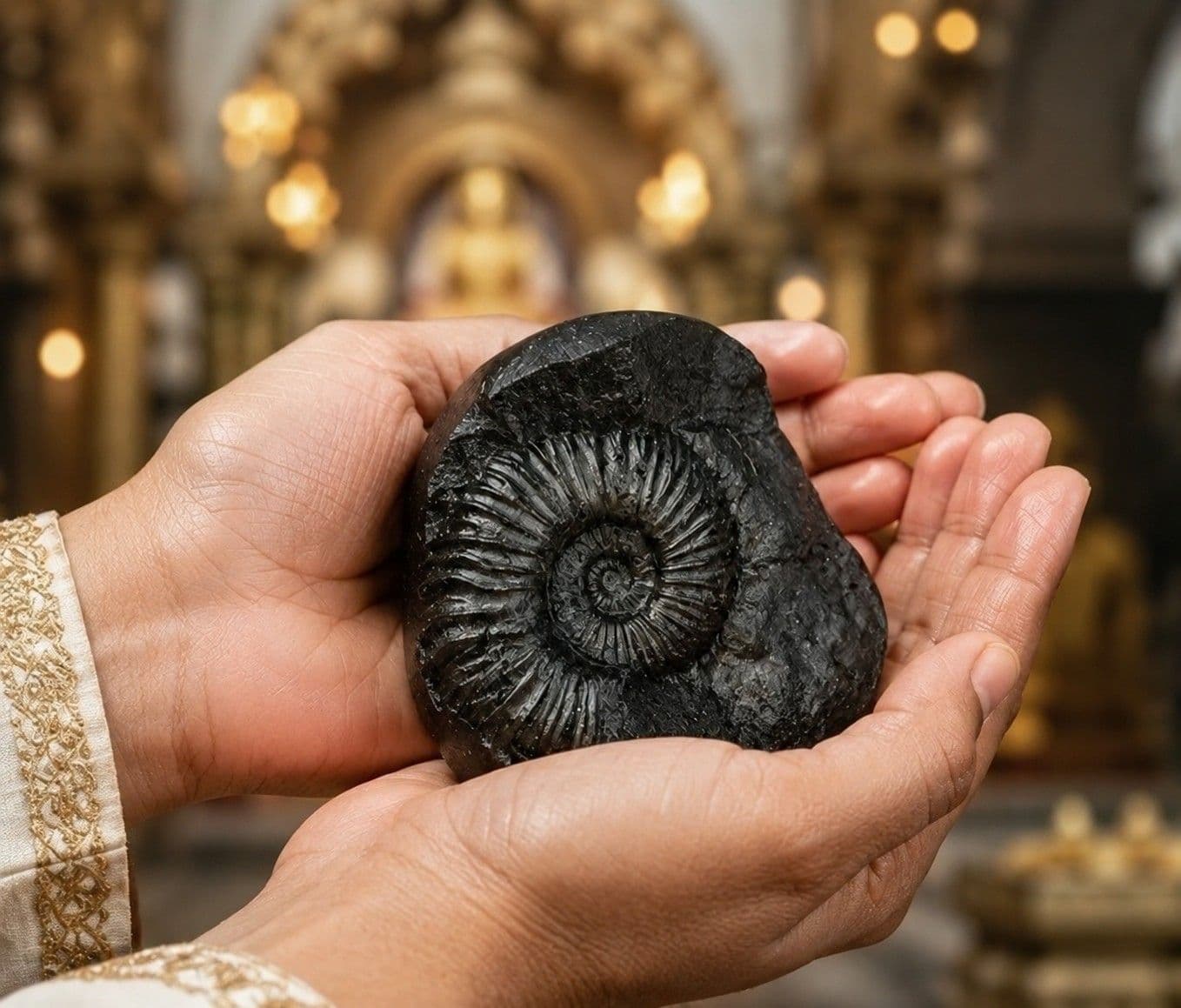
How to Identify an Authentic Shaligram
Knowing how to identify an authentic Shaligram is essential before purchasing, because ammonite fossils from outside the Gandaki River are increasingly being sold as genuine sacred stones. With the growing popularity of Shaligrams, the market has seen a rise in artificial pieces, misidentified fossils, and stones of unknown origin being presented without transparency.
An authentic Shaligram is a naturally fossilised ammonite stone collected exclusively from the Kali Gandaki River in Nepal, distinguished by its jet-black surface, natural chakra markings, and dense weight none of which can be accurately replicated by artificial means.
While no single method guarantees authenticity in every case, traditional practitioners and experienced collectors rely on a combination of physical observations, traditional tests, and trustworthy sourcing. This guide covers each of those methods in practical detail.
Quick Comparison: Authentic Shaligram vs Fake or Misrepresented Stone
| Feature | Authentic Shaligram | Fake or Other Ammonite |
| Chakra markings | Naturally irregular, organic | Too perfect or symmetrical |
| Surface | Smooth, cold, lustrous | May feel plastic or rough |
| Weight | Dense and heavy for its size | Often lighter than expected |
| Water test | No colour or coating releases | May release dye or surface material |
| Origin | Kali Gandaki River, Nepal | Unknown or other regions |
| Chakra edges | Slight natural variation in depth | Uniform, sharp, tool-marked |
1. The Gold and Silver Rubbing Test
One traditional method involves gently rubbing a piece of gold or silver against the surface of the Shaligram.
On an authentic Shaligram, gold or silver markings do not transfer easily due to the stone's natural density and smooth composition. On ordinary stones or artificially prepared pieces, metal streaks may appear more prominently or rub off onto the surface more easily.
This should be treated as an indicative observation rather than a definitive test. It is most useful when combined with the other methods below rather than used in isolation.

2. The Warm Water Test
Place the Shaligram in warm (not boiling) water, gently stir, and leave it for some time.
Watch carefully for:
- Unusual colour releasing into the water
- Artificial dye or pigment coming off the surface
- Excessive dust or surface coating dissolving into the water
- Any material visibly peeling, softening, or separating
A genuine Shaligram should retain its natural appearance without releasing artificial coatings or colour. If the water changes colour noticeably, or if surface material begins to separate, the stone may have been painted, chemically treated, or artificially prepared before sale.
3. Observe the Chakra Markings Carefully

Authentic Shaligrams possess naturally formed chakra (spiral) markings created over millions of years through the fossilisation process. These are not decorative they are the actual remains of the ammonite's internal shell structure.
Signs of an artificially carved or altered chakra:
- Extremely perfect and symmetrical spiral patterns
- Repetitive, uniform designs across the entire surface
- Visible tool marks or unnatural sharpness at marking edges
- Chakras that appear too clean or too precise compared to natural geological formation
Natural Shaligrams display subtle organic irregularities that reflect their geological origin. A genuinely formed chakra will have slight variations in depth, width, and direction that are very difficult to replicate accurately by hand carving or machine engraving.
4. The Most Difficult Challenge: Other Ammonite Fossils

Perhaps the trickiest aspect of Shaligram authentication is that ammonite fossils from rivers and regions outside the Gandaki can closely resemble genuine Shaligrams. In some cases, they may look and feel almost identical to an untrained eye.
This creates a genuine challenge for buyers because:
- Ammonite fossils exist in many parts of the world including India, Morocco, and Madagascar
- Some are similar in colour, weight, and surface texture to Kali Gandaki Shaligrams
- Even modern laboratory examinations and mineral certifications may not always determine whether a fossil originated specifically from the sacred Kali Gandaki River
- Sellers may genuinely not know the true origin of the fossil they are offering
Because of this, relying solely on certificates or any single physical test is not sufficient for confirming a genuine Shaligram.
5. When Should You Consult an Expert?
If you are considering purchasing a high-value, rare, or multi-chakra Shaligram, consulting someone with direct experience in Shaligram classification and Vaishnava tradition is strongly advisable before completing the purchase.
Situations where expert guidance matters most:
- You are purchasing a Shaligram described as rare or a specific named form of Vishnu [Vishnu Formed Shaligrams]
- The price is significantly higher than standard listings
- The seller cannot provide clear information about the stone's collection origin
- The chakra markings appear unusually perfect or the stone feels lighter than expected for its size
- You are purchasing for a household puja space and want confidence in the stone's authenticity and classification
An experienced classifier can identify the type of Shaligram, verify its chakra count and pattern, and provide guidance on its scriptural significance and correct method of worship.
Why the Source Matters More Than Any Single Test

For all the reasons above, the authenticity of a Shaligram depends not only on physical examination but equally on trust in its origin and sourcing.
A reputable and knowledgeable source should be able to clearly tell you:
- Where the Shaligram was collected specifically within the Kali Gandaki River region of Nepal
- How it was identified and classified by chakra count and type
- What form of Lord Vishnu it represents based on its markings
- Honest guidance on its significance and correct worship
Provenance knowing exactly where a stone was sourced is the layer of authentication that no physical test alone can replace. A seller who cannot answer basic questions about origin should be approached with caution regardless of any certificates provided.
At GemShakti, we emphasise responsible sourcing directly from the Gandaki River region of Nepal, careful individual classification of each stone, and honest guidance so that devotees can receive genuine sacred objects with full confidence and peace of mind.
A Final Note
No single test should be treated as absolute proof of authenticity. The most reliable approach combines traditional physical observations, natural chakra inspection, the warm water test, weight and texture assessment, and sourcing from a trustworthy supplier who understands both the spiritual and geological significance of these stones.
When in doubt, ask questions. A genuine source will always be willing to share the origin, classification, and individual details of each Shaligram they offer.
Frequently Asked Questions
How can I tell if a Shaligram is real or fake?
Look for natural chakra markings with slight organic irregularities, a jet-black smooth surface, and noticeable density for its size. Perform the warm water test to check for artificial dyes or coatings. Most importantly, verify the stone's origin from a reputable seller who can confirm it was sourced from the Kali Gandaki River, Nepal.
Can laboratory tests confirm a Shaligram is genuine?
Laboratory tests can confirm that a stone is a fossilised ammonite but cannot always confirm whether it originated specifically from the sacred Kali Gandaki River in Nepal. This is why physical tests must be combined with trustworthy sourcing rather than relying on certification alone.
What do fake Shaligrams typically look like?
Fake or misrepresented Shaligrams often have artificially carved chakra markings that appear too perfect and symmetrical, unusually light weight for their size, a plastic-like polished surface, or release colour or coating when placed in warm water. Some are genuine ammonite fossils from outside Nepal sold without disclosing their actual origin.
Is the gold and silver rubbing test reliable on its own?
No. The gold and silver rubbing test is a traditional indicative method, not a definitive test. On its own it cannot confirm authenticity. It is most useful as one observation among several alongside chakra inspection, the warm water test, weight and texture assessment, and verification of the stone's sourcing origin.
Why does the source of a Shaligram matter so much?
Because ammonite fossils from other parts of the world can closely resemble Shaligrams in appearance, the specific origin from the Kali Gandaki River in Nepal is what distinguishes a genuine Shaligram both scripturally and traditionally. Provenance is the layer of authentication that no physical test alone can replace, making trustworthy sourcing essential.