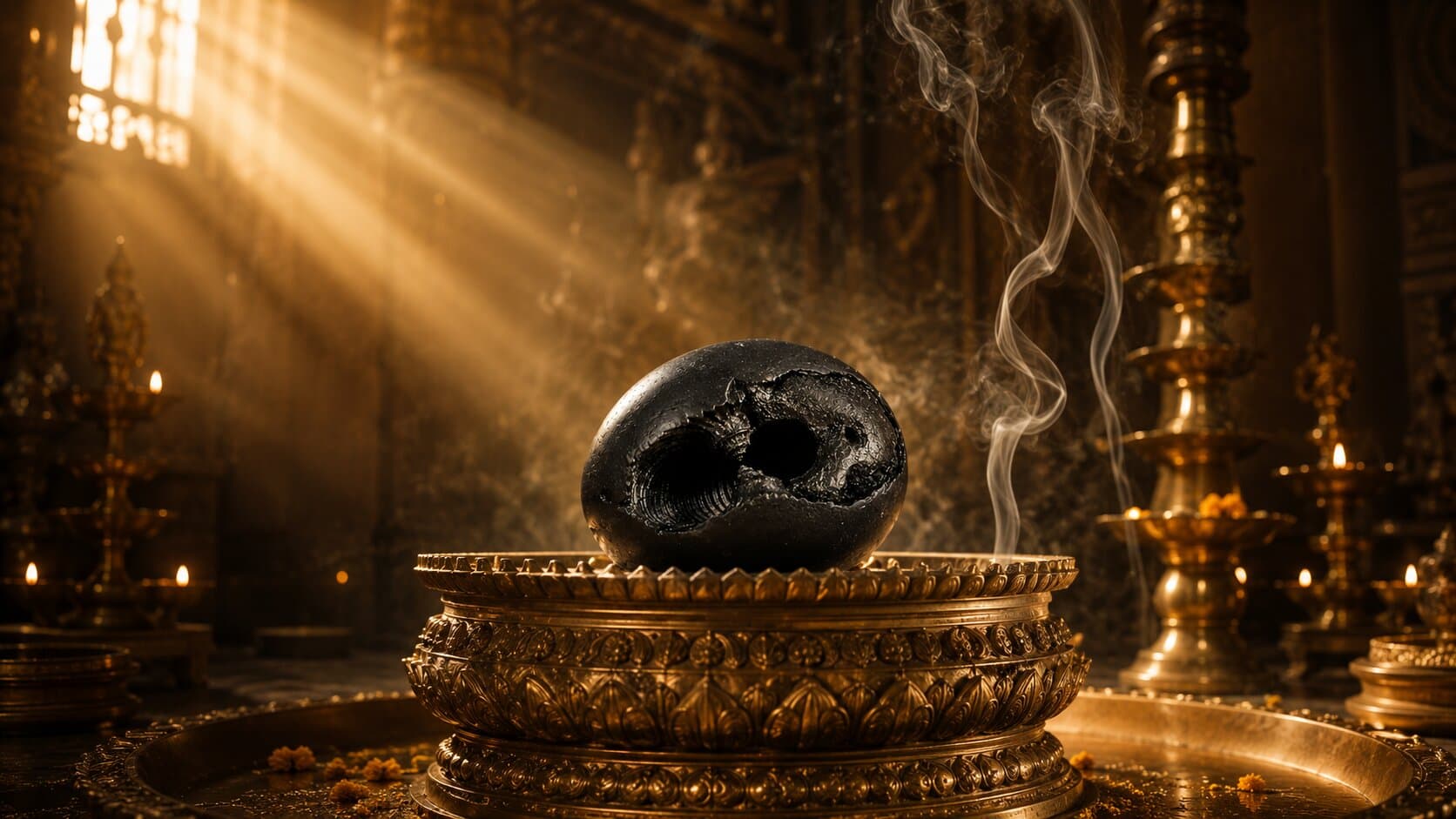
How to Identify a Genuine Shaligram Stone from Nepal: Tests, Signs & Scam Warnings
The market for fake Shaligrams is larger than most devotees realize. Carved black slate, painted river rocks, resin-cast replicas, and cement molds all are sold online and in local markets as authentic Shaligram Shilas. The consequences of worshipping a counterfeit are not merely spiritual; they represent a fundamental deception of the devotee's faith.
This guide gives you every tool you need to verify authenticity geological, traditional, and practical before you bring a stone into your home altar.
What Makes a Shaligram Genuine: The Baseline

A genuine Shaligram is a naturally fossilized ammonite the shell of an extinct marine cephalopod that lived in the ancient Tethys Sea between 100 and 300 million years ago. When the Indian tectonic plate collided with Eurasia and thrust the Himalayas skyward, these fossils were locked into the riverbed of what is now the Kali Gandaki River in the Mustang district of Nepal.
There is no other source. Every authentic Shaligram originates from a single river system on earth the Kali Gandaki, near the Muktinath pilgrimage site in Nepal. If a vendor cannot confirm this origin, the conversation ends there.
The Sudarshan Chakra the spiral discus marking that Vaishnavas recognize as Lord Vishnu's divine weapon is in fact the internal chamber structure of the ammonite shell, revealed over millions of years of fossilization and river erosion. It is not carved. It is not painted. It is geology expressing itself in the language of theology.
The Skanda Purana states that the presence of the Chakra marking is the ultimate defining characteristic of a true Shaligram even if the stone is chipped or broken. Conversely, the Garuda Purana classifies Shaligram Shilas based on their natural openings (Mukha), Chakra count, and color a taxonomy only possible because these features arise naturally, not by human craft.
5 Reliable Tests to Identify a Real Shaligram at Home

1. The Weight Test
Pick up the stone. An authentic Shaligram is unusually heavy for its size. Over millions of years, the original organic shell is replaced by dense minerals silica, iron, and calcite through a process called permineralization. The result is a stone that consistently surprises people with its weight relative to its dimensions. A resin or cement fake will feel noticeably lighter, and a painted river rock will feel like an ordinary stone.
2. The Gold or Silver Rub Test
This is the most trusted traditional test and one that holds up to basic materials science. Take a piece of real gold or silver a coin, a ring, or a small piece of jewelry and rub it firmly across the smooth surface of the stone. On a genuine Shaligram, the metal leaves a semi-permanent glittery streak that does not wipe away easily. This happens because the dense mineral matrix of the fossilized stone has a high surface affinity for soft metals like gold and silver.
On a painted rock, resin fake, or lacquered slate, the metal streak either does not form at all, or it wipes off completely with a single touch. No streak not genuine.
3. The Hot Water Test
Place the stone in hot (not boiling) water for two to three minutes, then remove it and rub the surface firmly with your fingers. Two things to watch for:
- If the water turns black or dark -> the stone has been painted or coated. Fake.
- If your fingers feel sticky or waxy -> the stone has been coated with M-seal, epoxy, or resin to conceal carving marks or fill cracks. Fake.
A genuine Shaligram's water remains clear. The stone's surface feels clean and uniformly smooth the result of millions of years of river erosion, not chemical treatment.
4. The Visual Suture Test

Examine the Chakra markings closely ideally under a magnifying glass or phone macro lens. On a genuine Shaligram, the spiral lines are fossil sutures: the natural boundaries between the ammonite's internal chambers. They have:
- Varying depth some areas deeper, some shallower
- Organic, slightly irregular width
- Natural asymmetry no two points on the spiral are perfectly equidistant
On a carved fake, the lines have uniform depth and width the mechanical signature of a rotary tool. Under magnification, you will see the tool marks. The Skanda Purana's insistence on natural irregularity as proof of divine origin is, quite literally, also the geologist's criterion for distinguishing a fossil from a carving.
5. The Uniqueness Test
Nature never produces identical ammonite fossils. Every genuine Shaligram is completely unique in its Chakra placement, opening shape, size, and surface texture. If a vendor is offering multiple Shaligrams that look identical same size, same spiral position, same opening they are mass-produced from a mold. Real stones sourced from the Kali Gandaki are as individual as fingerprints.
Red Flags: Signs of a Fake Shaligram
| FeatureGenuine Gandaki ShaligramFake /Counterfeit | ||
| Chakra markings | Organic, varying depth, asymmetric | Perfectly uniform, machine-carved |
| Opening (Mukha) | Natural cavity, uneven edges, internal spiral | Perfectly circular, drill-smooth edges |
| Weight | Unusually heavy for size | Lighter (resin) or standard rock weight |
| Surface | Naturally river-smoothed, matte to semi-gloss | Artificially shiny, painted, or patchy |
| Gold rub test | Leaves a semi-permanent metal streak | No streak, or streak wipes off instantly |
| Hot water test | Water stays clear, surface feels clean | Water darkens, surface feels sticky |
| Uniqueness | Completely individual — no two alike | Multiple identical copies available |
The M-Seal Scam: What Most Buyers Don't Know
One of the most sophisticated fakes in circulation involves the use of M-seal or epoxy putty a commercial adhesive sealant applied over a carved or drilled stone to fill tool marks and give the surface a smooth, seemingly natural finish. Once dried and painted black, these stones are nearly indistinguishable from genuine Shaligrams at a glance.
The hot water test reliably exposes this. M-seal softens slightly under sustained heat and becomes noticeably sticky to the touch. It may also begin to peel at edges, or the paint over it may bubble. Any stickiness whatsoever under hot water is an immediate disqualifier.
What "Perfectly Round" Really Means
Vedic Archakas (temple priests) consistently warn against Shaligrams with perfectly circular, smooth-edged openings. A natural Mukha (mouth/opening) in a Shaligram is formed by the ammonite's original body chamber and shaped by millions of years of river erosion. It is never perfectly circular. It has a natural, slightly irregular perimeter and internal walls that curve organically.
A perfectly round hole with smooth, uniform walls was made by an electric drill. It voids the Swayambhu nature of the stone entirely. No matter how beautiful it looks, a drilled Shaligram is a disqualified one in the eyes of both scripture and geology.
Two Common Myths Debunked
- Myth: A genuine Shaligram should look perfectly symmetrical and beautiful. — The opposite is true. Natural perfection is organic imperfection. Perfect symmetry is the mark of a machine, not millions of years of geological process. The irregularity IS the authenticity.
- Myth: Shaligrams can be found in other rivers in India. They cannot. The specific combination of geological conditions — the Tethys Sea fossil bed, the Kali Gandaki's erosive force, and the Himalayan mineral composition exists nowhere else. Stones sold as "Indian Shaligrams" from other rivers are either Bhadraksha stones or carved fakes.
How to Buy an Authentic Shaligram
- Ask for origin confirmation the vendor must be able to state Kali Gandaki, Mustang district, Nepal as the source.
- Never buy from vendors offering identical multiples one set of identical twins disqualifies an entire collection.
- Request a photograph of the opening interior genuine Mukhas show internal spiral chambers. Drilled holes show nothing inside.
- Remember Dakshina a Shaligram is not sold. What you pay is a donation for the labor of sourcing. Any vendor treating it purely as a retail product should be viewed with suspicion.
At GemShakti, every Shaligram in our collection is individually sourced from the Kali Gandaki region, documented for origin, and presented with a photograph of the natural Mukha and Chakra formation. Explore our authenticated Shaligram collection — each stone as unique as the grace it carries.