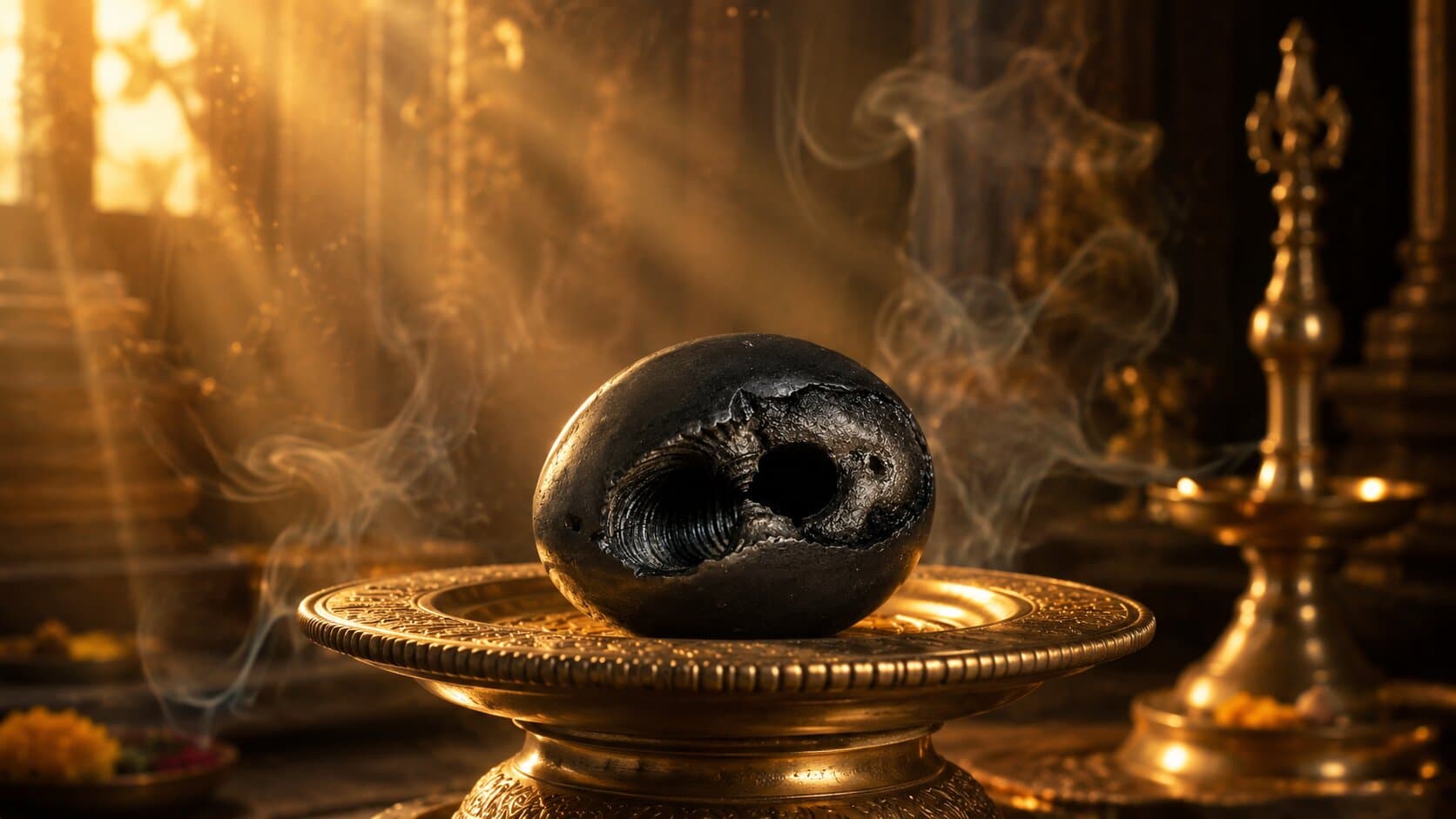
Shaligram Stone Benefits: Spiritual Power, Scientific Truth & Daily Worship Guide
The Shaligram stone is not carved by any human hand. It is not installed in a temple by a priest. It requires no Prana Pratishtha no ritual to awaken the divine within it because, according to every major Vaishnava scripture, Lord Vishnu already dwells inside it. That is what makes the Shaligram uniquely, irreducibly sacred: it is Swayambhu self-manifested.
But what does keeping one at home actually do? And how do you know if the black stone you are looking at is the real thing? This guide answers both questions completely drawing from the Padma Purana, Skanda Purana, and Garuda Purana, as well as modern geological science.
What Is a Shaligram Stone?

A Shaligram (also spelled Shalagram or Salagrama Shila) is a naturally occurring sacred stone found exclusively in one place on earth: the Kali Gandaki River Gorge in the Mustang district of Nepal, near the Muktinath temple. Geologically, these are fossilized shells of extinct marine creatures called ammonites mollusks that lived in what is now the Himalayan region when it was still the bed of the ancient Tethys Sea, over 66 to 400 million years ago.
When the Indian tectonic plate collided with the Eurasian plate and pushed the Himalayas skyward, these fossils were carried up with the rock preserved, mineralized, and eventually tumbled smooth by the fast-flowing Kali Gandaki over millions of years. The result is a dense, jet-black stone bearing the unmistakable spiral of the ammonite shell which Vaishnavas recognize as the Sudarshana Chakra, the divine discus of Lord Vishnu.
Science and scripture, here, are telling the same story from different languages.
Top Benefits of the Shaligram Stone

The benefits attributed to the Shaligram stone span the spiritual, the material, and the protective. Here is what the scriptures specifically state not paraphrased legend, but documented Puranic references.
1. Transforms Your Home Into a Place of Pilgrimage
The Skanda Purana (Kartika Mahatmya) declares that any house containing a Shaligram stone is equivalent to a Tirtha a sacred pilgrimage site. Yamaraja, the lord of death and karmic consequences, is said to avoid entering such a home. In practical terms, the stone is believed to cleanse the home's energy field, remove accumulated negative karma, and create an environment where positive, sattvic (pure) energies prevail.
2. Grants Liberation (Moksha)
The Garuda Purana states that a dying person given water that has bathed a Shaligram, or who passes in the presence of the stone, attains safe passage to Vaikuntha Lord Vishnu's eternal abode. This is not a minor claim. In Vaishnava theology, liberation from the cycle of birth and death (Samsara) is the ultimate goal of all spiritual practice, and the Shaligram is held to grant it.
3. Dissolves the Sins of Past Births
The Padma Purana states that bathing the Shaligram and drinking its water called Charanamrita (the nectar of the Lord's feet) absolves a devotee of the accumulated sins of millions of past lives. This is the doctrinal basis for the practice of drinking the small amount of water used to bathe the stone each morning during daily worship.
4. Invites the Grace of Goddess Lakshmi
Where Lord Vishnu resides, Goddess Lakshmi is never absent. Keeping a Shaligram in the home pooja room is traditionally understood as the surest invitation for Lakshmi's blessings wealth, abundance, and domestic harmony. Many families report that regular Shaligram worship over time brings a tangible stabilization and improvement in financial circumstances, though Vaishnava priests consistently note that this is a by-product of Bhakti (devotion), not the primary goal.
5. Corrects Vastu Defects
Vastu Shastra experts recommend placing the Shaligram in the Northeast corner (Ishan Kona) of the home or pooja room. This direction is considered the zone of divine energy and cosmic receptivity. A Shaligram placed here is believed to neutralize Vastu doshas (architectural energy defects) that may be causing obstacles in health, wealth, or relationships without any structural changes to the home.
6. Mental Peace and Clarity
Daily worship of the Shaligram the act of rising early, offering water, placing Tulsi, lighting a lamp, and chanting establishes a morning rhythm that anchors the mind. Practitioners consistently report reduced anxiety, sharper focus, and a quiet inner resilience that develops over weeks of consistent practice. Whether this is attributed to divine grace or the neurological effects of morning ritual and meditation is a matter of perspective. The result, in either case, is real.
Shaligram Stone vs. Traditional Deity Murti Key Differences
| FeatureShaligram StoneTraditional Murti (Idol) | ||
| Origin | Naturally formed ammonite fossil | Man-made, carved or cast |
| Consecration | Swayambhu no ritual required | Requires Prana Pratishtha |
| If Damaged | Remains divine even if chipped or cracked | Must be respectfully immersed if broken |
| Home Worship | Fully safe for home worship at any size | Large murtis often need temple-level upkeep |
| Core Requirement | Must be offered Tulsi leaves | Tulsi preferred but not always mandatory |
How to Worship Shaligram Stone at Home: Daily Routine

The Shaligram does not demand elaborate ceremony. It demands consistency and sincerity. Here is the complete daily worship routine any householder can follow:
- Step 1 -> Cleanse yourself: Take a bath before touching the stone. The Shaligram responds to purity of body and mind.
- Step 2 -> Bathe the stone: Gently pour a small amount of clean water, milk, or Panchamrita (milk, curd, honey, ghee, sugar) over the stone. This is the Abhisheka.
- Step 3 -> Collect the water: The water used to bathe the Shaligram is Charanamrita. Distribute it to family members to drink a few drops each. This is the core spiritual practice.
- Step 4 -> Offer Tulsi: Place one or two fresh Tulsi (Holy Basil) leaves on the stone. This is non-negotiable. Traditional belief holds that the Shaligram will not accept any offering made without Tulsi.
- Step 5 -> Light a lamp and incense: A simple ghee lamp and one incense stick are sufficient. Chant Om Namo Narayanaya or the Vishnu Sahasranama, or simply sit in silent devotion for a few minutes.
- Step 6 -> Offer flowers and naivedya: A small piece of fruit or sweet offered as prasad completes the puja. Offer, bow, and receive the prasad.
Can I miss a day? Lord Vishnu is Parameshvara the most compassionate preserver. The scriptures are clear that unintentional misses due to travel, illness, or emergency do not attract penalties. What matters is the sincere intention to maintain the daily relationship. Resume as soon as possible without guilt.
How to Identify an Original Shaligram Stone

The market for fake Shaligrams typically carved black slate or resin is significant. Here is how to verify authenticity before acquiring one.
- Weight: Authentic Shaligrams are heavily mineralized with silica and iron. They feel noticeably heavier than their size would suggest.
- The Chakra (spiral): The internal ammonite chamber leaves a naturally perfect geometric spiral ridge inside or on the surface of the stone. Fakes have crude, hand-carved spirals that lack the mathematical precision of a natural fossil.
- Surface texture: Real Shaligrams are smooth and jet black, often with golden or bronze streaks (pyrite inclusions) inside the spiral. These are not defects they are geological signatures.
- Origin verification: Every authentic Shaligram comes from the Kali Gandaki River in Nepal. If a vendor cannot confirm Nepali Gandaki origin, be extremely cautious.
- The water test: A real Shaligram, when placed in clean water, should not dissolve, discolor the water significantly, or leave residue. Painted or resin-coated fakes often bleed color.
Buying a Shaligram: The Rule of Dakshina
According to Vedic tradition, a Shaligram stone cannot be bought or sold. It is considered priceless. What one pays is Dakshina — a donation offered to the person who undertook the labor and risk of traveling to the Gandaki gorge to source it. This is not a semantic distinction; it reflects the understanding that Lord Vishnu cannot be transacted. He can only be received as grace.
Only trust vendors or organizations who can clearly state the stone's sourcing from the Muktinath / Kali Gandaki region of Nepal, and who present it with appropriate reverence rather than as a commercial product.
Common Myths Debunked
- Myth: Women cannot touch the Shaligram. This is not found in the primary scriptural sources. Women have been Vaishnavas and Shaligram worshippers throughout history. Menstruating women are advised to pause the puja, as with any deity worship, but are not prohibited from the stone's presence.
- Myth: You need a priest to install it. No. The Shaligram is Swayambhu self-manifested. It requires no Prana Pratishtha and no priestly installation. Any sincere devotee can begin worship immediately.
- Myth: A chipped or cracked Shaligram brings bad luck. The opposite of what applies to carved idols. The Shaligram retains its full divine status regardless of physical damage. It cannot be "broken" spiritually.
Final Word
The Shaligram stone is not a lucky charm. It is not a decorative object for the display shelf. It is a 66-million-year-old geological miracle that the Vaishnava tradition recognizes as the living, self-manifested presence of Lord Vishnu in physical form a presence that turns a household into a pilgrimage, a bath into liberation, and a daily routine into devotion.
If you are considering bringing a Shaligram into your home, begin with one question: are you ready to offer it consistency and sincerity? That is all it asks. Everything else the peace, the protection, the grace of Lakshmi, and ultimately the path toward Moksha follows naturally from that daily commitment.
Explore our collection of authenticated, Gandaki-sourced Shaligram stones each verified for origin, weight, and natural Chakra formation, presented with the reverence this sacred stone deserves.