Shaligram Stone Myths vs Facts: Science, Legends & Truths
Shaligram Stone Myths vs Facts: Science, Legends & Truths
The sacred Shaligram stone is revered across Sanatana Dharma as a living manifestation of Lord Vishnu, yet it remains shrouded in widespread myths, unnecessary superstitions, and ritual anxieties. Well-meaning devotees often refrain from welcoming a sacred Shila into their homes because of unfounded beliefs—such as fear of severe curses if a ritual is missed, or the myth that women cannot worship it.
By examining primary Vedic texts alongside modern geological paleontology, sincere practitioners can separate scriptural truth and natural science from modern misunderstandings.
Myth 1: "Women Are Not Allowed to Worship a Shaligram"
- The Reality: Untrue. Vedic scriptures encourage women to worship the Shaligram with devotion.
- The Scriptural Evidence: In classical Vaishnava traditions and scriptures such as the Padma Purana, devotion (Bhakti) transcends gender, age, and caste. Goddess Mahalakshmi herself is eternally united with Lord Vishnu within the Shila. Women have worshipped Shaligram stones for centuries across traditional lineages, offering water, flowers, and fresh Tulsi leaves.
- The Only Rule: Sincere inner cleanliness and respect are the sole conditions, which apply equally to men and women.
Myth 2: "If a Shaligram Is Chipped, Cracked, or Broken, It Brings Bad Luck"
- The Reality: Untrue for natural river fossils.
- The Scriptural Evidence: While traditional marble or clay murtis require Visarjan (immersion) if cracked, the Varaha Purana explicitly states that an authentic Shaligram from the holy Shalagrama-kshetra never loses its divine presence, even if naturally fractured, broken, or weathered.
- The Distinction: Because an authentic Shila is a million-year-old river-tumbled fossil, natural fractures and exposed inner chambers are a sign of geological antiquity, not inauspicious damage. Only artificially damaged or machine-carved fake replicas lack sanctity.
Myth 3: "Missing Daily Puja Incurs Severe Divine Wrath"
- The Reality: Untrue. Devotion is based on love and surrender (Sharanagati), not fear.
- The Scriptural Evidence: Lord Vishnu is known as Bhaktavatsala—merciful and affectionate toward devotees. If travel, sudden illness, or emergencies prevent you from offering daily water and Tulsi, offering simple mental worship (Manasa Puja) maintains spiritual connection.
- Best Practice: When leaving home for extended periods, simply keep the Shila immersed in clean water or respectfully entrust its care to a family member.
Myth 4: "Science and Scripture Contradict Each Other About Shaligrams"
- The Reality: Science and scriptural tradition describe the exact same physical reality through two different lenses.
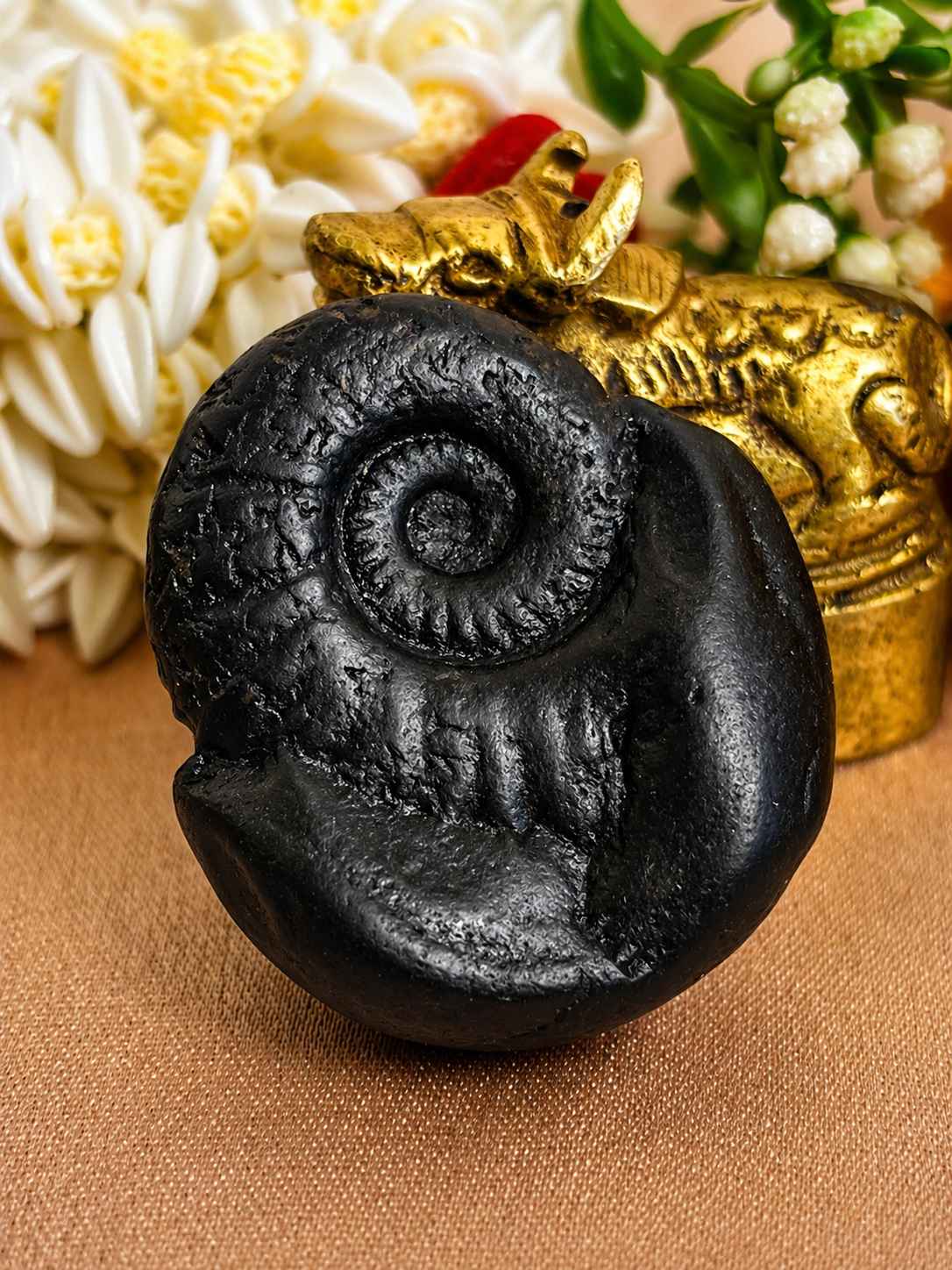
- The Scientific Fact: Paleontology confirms that Shaligrams are authentic ammonite fossils (cephalopods) that lived in the warm, shallow waters of the prehistoric Tethys Ocean during the Jurassic and Cretaceous eras (66 to 150+ million years ago). When the Indian tectonic plate collided with the Eurasian plate to form the Himalayas, these marine deposits rose thousands of meters above sea level to form northern Nepal's Spiti Shales.
- The Puranic Concordance: Ancient texts describe the Gandaki River as an ancient sacred water basin where divine marine forms were preserved in stone. The spiral patterns celebrated as the Sudarshan Chakra are the fossilized, fractal suture lines of the ammonite shell chambers. The scientific origin does not diminish its sacredness; it illustrates how natural cosmic forces sculpted these emblems over deep time.
Myth 5: "The Spiral Chakra Was Carved by Diamond Worms (Vajrakita)"
- The Legend: Traditional folklore often recounts that sacred diamond-toothed insects called Vajrakita chiseled the spirals inside the river rocks.
- The Scientific & Symbolic Truth: The term Vajrakita was an insightful pre-modern attempt to explain how intricate, mathematically perfect spiral cavities were hollowed out inside extremely hard shale without human tools. Modern geology proves these spirals are the internal septal walls of ancient ammonite shells, naturally exposed and hollowed out over centuries by the abrasive waters and river grit of the Kali Gandaki.

Summary: Myths vs. Scriptural & Scientific Facts
| Common Myth | Vedic & Scientific Reality |
| "Only temple priests can worship them" | Householders (Grihasthas) can worship the Shila with simple daily water and Tulsi. |
| "Any black river stone is a Shaligram" | Only natural ammonite fossils from Nepal's Kali Gandaki River carry authentic identity. |
| "Damaged Shilas must be discarded" | Natural river fractures never diminish the inherent divinity of a genuine Shila. |
| "Women cannot perform daily puja" | Anyone with a clean heart, pure intent, and devotion can honor the sacred Shila. |
| "Science disproves Shaligram holiness" | Geology validates their unique origin from the ancient Tethys Ocean beds of the Himalayas. |
Ground Your Devotion in Scriptural Authenticity
Approaching the sacred Shaligram with grounded understanding and reverent love frees your spiritual practice from superstitious fear. The divine presence in your home thrives on sincere devotion, a fresh Tulsi leaf, and respect for its genuine Himalayan origin.
At Gemshakti, every Shila is ethically retrieved directly from the sacred riverbeds of Muktinath and verified for natural geological ammonite formations.
Welcome genuine divine grace into your household with our certified Kali Gandaki Shaligram Collection or explore a sacred Laxmi Narayan Shaligram to anchor your family worship in truth and purity.