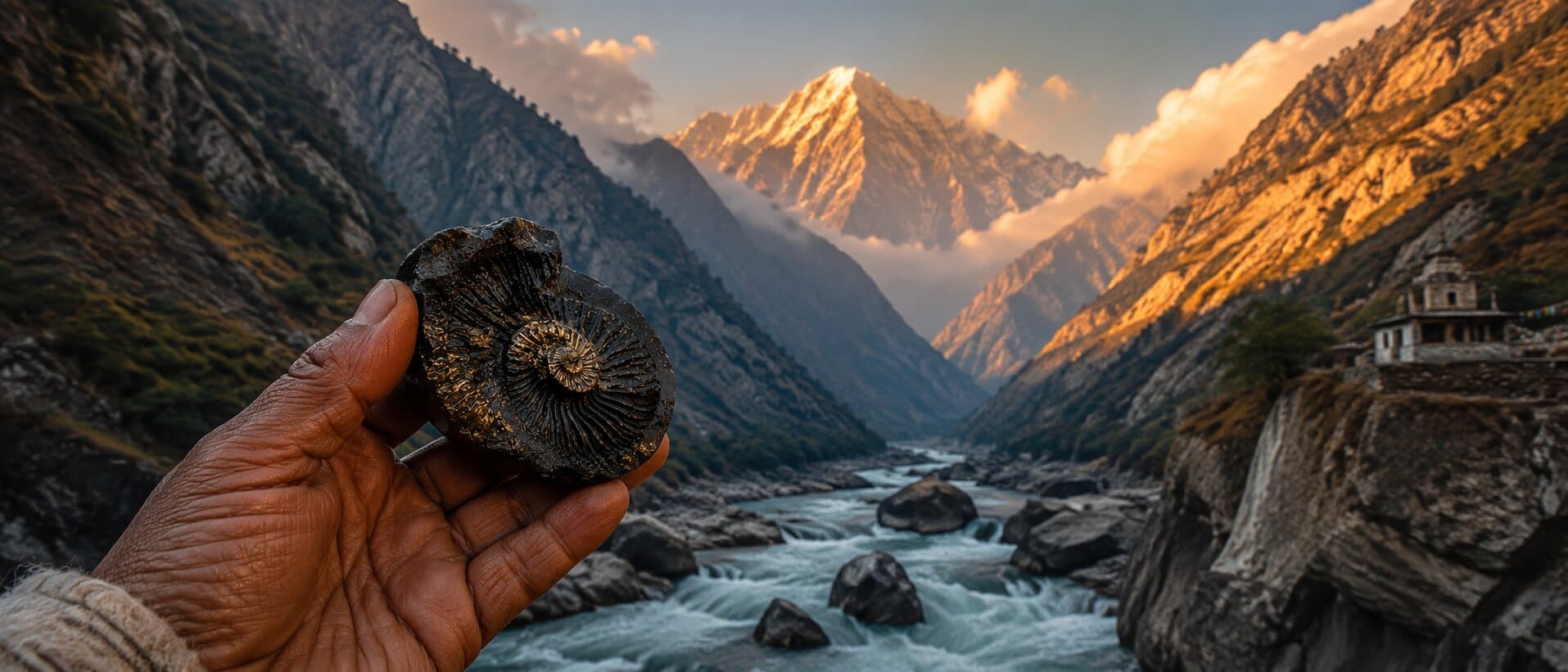
What is a Shaligram Stone?
A Shaligram, also spelled Shaligram Shila, is a naturally occurring fossil stone found only in the Kali Gandaki River in Nepal. In Hinduism, and particularly within Vaishnavism, it is worshipped as a direct, non-anthropomorphic form of Lord Vishnu meaning devotees don't just see it as a symbol of Vishnu, but as Vishnu himself present in stone. This is what sets Shaligram worship apart from most other forms of murti (idol) worship, where an image is consecrated through ritual before it is considered fit for worship. A Shaligram is considered inherently sacred in its natural state, without needing that separate act of consecration which is part of why devotees treat sourcing and authenticity as so important.
How a Shaligram Is Formed
Geologically, Shaligrams are fossilised ammonites marine molluscs that lived roughly 140 to 165 million years ago, when the rock that now makes up the Himalayas was still part of the ancient Tethys Sea floor. As the Indian and Eurasian tectonic plates collided and pushed that seabed upward over millions of years to form the Himalayan range, these fossils were carried up with it, embedded deep in the rock. Since then, the Kali Gandaki River has cut through and eroded the surrounding stone, gradually washing the fossils downstream and shaping their surface into the smooth, spiral-marked stones collected today. The distinctive circular "chakra" markings devotees look for are the fossilised imprint of the ammonite's original shell structure, and no two Shaligrams are ever perfectly identical each one's markings, size, and colour are the product of a unique, multi-million-year geological history.
Why Only from the Kali Gandaki River, Nepal
Shaligrams are sourced directly from the Kali Gandaki River, which flows near Muktinath and Damodar Kunda in Nepal sites that are themselves significant Vaishnava pilgrimage destinations, drawing devotees from across South Asia. This specific combination of ancient marine fossil deposits and a river system capable of naturally exposing and polishing them over millions of years is not replicated anywhere else on Earth. This is why authentic Shaligrams cannot be found, mined, or manufactured elsewhere no other location produces the same fossil type in the same naturally worn form. It's also why sourcing and origin matter so much when buying one: a Shaligram's authenticity is tied directly to where, and how, it was collected, not just to how it looks.
The Story Behind the Stone
Several Puranic texts, including the Padma Purana, Skanda Purana, and Devi Bhagavata Purana, describe the origin of the Shaligram through the story of Vrinda (also known as Tulsi) and her husband Jalandhar. According to this account, Vishnu intervened to defeat Jalandhar, and Vrinda's curse in response to that intervention transformed Vishnu into stone the Shaligram while she herself became the sacred Tulsi plant. This is the traditional basis for why tulsi leaves are offered in Shaligram worship even today; the two are considered eternally connected. Different Puranas tell this story with variations in detail, and interpretations differ across lineages and regional traditions, but the core association between Shaligram, Vishnu, and Tulsi is consistent across Vaishnava tradition as a whole.
How Shaligrams Are Worshipped
In most Vaishnava households that keep a Shaligram, daily worship centres on abhishekam ceremonial bathing of the stone, typically with water, milk, or panchamrit (a mixture of milk, yogurt, honey, ghee, and sugar) followed by offerings of tulsi leaves and, in many traditions, food (bhog) that is later considered blessed prasad. Shaligrams are traditionally kept in a clean, dedicated space, often alongside other family deities, and are never drilled or physically altered in any way, since their natural, unworked form is considered essential to their sanctity this is one of the few rules observed fairly consistently across different traditions. Specific rituals, mantras, and timing otherwise vary quite a bit by family and regional tradition, which is why many households follow guidance passed down within their own lineage rather than a single fixed procedure applied everywhere.
Different Types of Shaligram
Not all Shaligrams are considered the same. Devotees and scholars traditionally classify them by their markings, colour, and the number and pattern of chakras, and different types are associated with different forms of Vishnu:
Vishnu Shaligram is among the most commonly worshipped and recognised forms, typically identified by clear, well-defined chakra markings. Laxmi Shaligram is associated with wealth and prosperity, and is often sought by households and business owners specifically for that reason. Sudarshan Shaligram, marked by a distinct discus-like pattern, is considered rare and is prized particularly by collectors and serious devotees. Dashavatar Shaligram is one of the more elaborate varieties, believed to represent all ten avatars of Vishnu within a single stone, and is generally reserved for advanced or long-established worship practices. Each type is believed to carry a distinct significance, and many collectors and devotees seek out a specific variety depending on their family tradition, personal devotion, or the specific blessing they associate with it.
A Quick Note on Identification
Because demand for Shaligrams has grown, so has the market for carved or altered fakes. A few basic signs are worth knowing even before you buy: genuine chakra markings tend to look naturally irregular rather than perfectly symmetrical, and the stone's overall texture should feel smooth and river-worn rather than freshly cut. This topic deserves its own deeper treatment we've published a full identification guide covering this in detail, including photos from our own inventory.
Buying an Authentic Shaligram
Because Shaligrams can only form in one river system, authenticity comes down almost entirely to verifiable sourcing rather than appearance alone. Look for sellers who can speak specifically to where and how a stone was collected, rather than relying on generic claims of authenticity. At GemShakti, every Shaligram we sell is sourced directly from the Kali Gandaki River, Nepal, and verified by our team in Kathmandu before it's listed you can browse our full Shaligram collection to see the varieties currently available, including Vishnu, Laxmi, Sudarshan, and Dashavatar Shaligrams.
FAQs:
Q1: What makes a Shaligram Shila different from other Hindu idols (murtis)?
A: Unlike traditional Hindu murtis that require a distinct ritual of consecration (prana pratishtha) to become fit for worship, a Shaligram is considered inherently sacred in its natural state. In Vaishnavism, it is worshipped not merely as a symbol of Lord Vishnu, but as a direct, living, non-anthropomorphic manifestation of Vishnu himself. Because it is already divine, it is never drilled, carved, or physically altered.
Q2: How are Shaligrams geologically formed, and why are they only found in Nepal?
A: Geologically, Shaligrams are the fossilized remains of prehistoric marine mollusks called ammonites, which lived 140 to 165 million years ago in the ancient Tethys Sea. When the Indian and Eurasian tectonic plates collided, the seabed was pushed up to form the Himalayas. Over millions of years, the Kali Gandaki River in Nepal cut through these rock layers, naturally eroding, smoothing, and washing the fossils downstream. This precise combination of ancient marine deposits and specific river erosion exists nowhere else on Earth.
Q3: Why are Tulsi leaves always offered during Shaligram worship?
A: The connection comes from Puranic texts (such as the Padma Purana and Skanda Purana). According to the legends, Vishnu was cursed by a devout woman named Vrinda (Tulsi) to turn into stone—becoming the Shaligram—while she transformed into the sacred Tulsi plant. Because of this eternal spiritual bond, daily Shaligram abhishekam (ceremonial bathing) is traditionally completed by offering fresh Tulsi leaves.
Q4: What are the main types of Shaligrams and their spiritual benefits?
A: Shaligrams are classified by their color, shape, and the pattern of their circular chakra markings:
- Vishnu Shaligram: Identified by clear, well-defined chakras; brings peace and protection to households.
- Laxmi Shaligram: Associated with the Goddess of wealth; sought out by families and businesses for prosperity.
- Sudarshan Shaligram: Features a distinct, sharp discus-like pattern; highly prized by serious devotees for removing negative energies.
- Dashavatar Shaligram: A rare variety representing all ten incarnations of Vishnu, typically reserved for advanced spiritual practitioners.
Q5: How can I identify a fake Shaligram from a genuine one?
A: Due to high market demand, fake or altered stones are common. Genuine Shaligrams feature chakra spiral markings that are naturally irregular and asymmetrical, as they are organic prehistoric imprints. The texture should feel smooth and naturally river-worn. If the markings look perfectly symmetrical, uniform, or show signs of tool cuts and drilling, the stone has likely been artificially carved or manipulated.
Q6: Where can I buy an authentic Shaligram stone safely?
A: Authenticity relies entirely on verifiable sourcing from the Kali Gandaki River system near Muktinath or Damodar Kunda in Nepal. When buying, avoid sellers making generic claims. Look for trusted platforms like GemShakti, where every single stone is directly sourced from the sacred riverbanks of Nepal and verified by experts in Kathmandu before being made available to devotees.